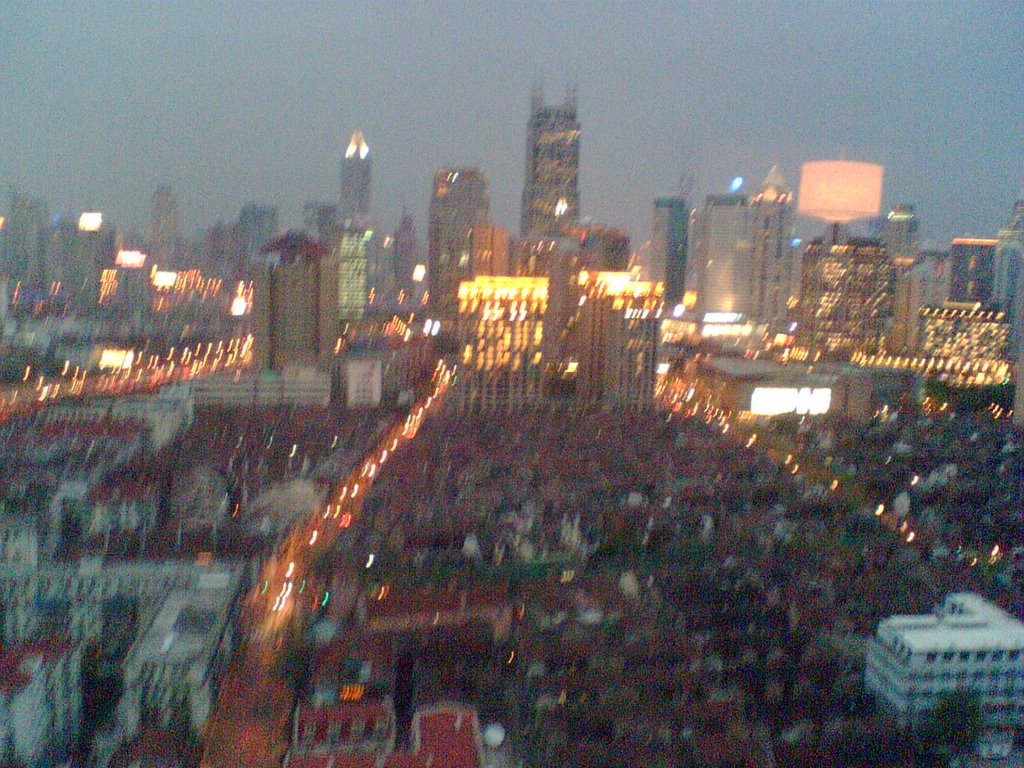
New York City is the skyline of my past, and Hong Kong is the skyline of the present. But I live in Shanghai, which is the skyline of the very near future.
One night a few years ago I found myself hurtling through the soft Hong Kong night in a taxi, when I saw the bleary lights of the endless New Territories high-rises for the first time. I was on my way to Central from the airport, and as I hummed past these Cantonese corridors of humanity they came into focus, blinking and twinkling on either side of me. I cracked the window and was awestruck. Who lives there? I asked myself. What are they doing? I wanted to know.
I have never had that feeling about Shanghai. In fact I have often wondered, how can a city of twenty million souls have so little soul? And how can a small, overcrowded archipelago of concrete and jungly rocks have so much of it?
Having spent the best part of my formative years living on the jagged hemline between Chinatown and the Lower East Side of Manhattan, I got to know the habits – the smells and sounds - of an extended Hong Kong. In those days you never heard Mandarin spoken downtown, only Cantonese. The first time I ever heard Mandarin was on cable TV, and I got into an argument with my brother, who said it was ‘Chinese’. But this shushing, fluttering of birds’ wings didn’t sound anything like the long vowels or comedic groaning we heard from Bruce Lee and Billy Chong every Saturday morning on Kung Fu Theater. Somebody had changed the channel.
The Chinatown of my youth was the Pearl River Market on Canal Street, an inscrutable emporium filled with silks, teak wood and porcelain, and the Rosemary theater on East Broadway, where it joins forces with the Bowery and pours over the Manhattan Bridge; a place where you could walk in and be alone sometimes in the afternoon, watching a Kung Fu dazzler or a whacky screwball comedy. And there were endless jingly, smoky little shops selling Double Happiness and Year of the Tiger posters, along with huge red marriage candles and temple incense; a million little tsotchkes that snake charmed me and fired the wanderlust of my imagination. It was a constantly evolving place, Chinatown, and even though I lived there for almost twenty years I never got bored of walking around its grimy, rat-trap streets. Every single day I saw something that I’d never noticed before.
My morning ritual always involved a stroll around the neighborhood; down to the news stand for the New York Post I would walk in my sweat pants and sandals, by the F train at East Broadway and Canal. They had Hong Kong Playboy and Penthouse magazines there, and as if that wasn’t exotic enough they also had an array of brightly colorful boxes containing wild elixirs and unknown potions behind the counter. Being a man of habits they knew me well in there, and one day when I went to pay for my paper the sharp eyed lady who ran the place saw I had a cut on my hand where my cat had scratched me. In a flash she produced a bottle of mysterious brown liquid and rubbed some on the wound, and it smelled strange, tangy and sweet. I don’t remember if it healed the cut any faster, but I searched all of that afternoon looking for the formula, and finally found it in a cramped traditional medicine shop on Pell Street. The psychedelic sixties poster of its label read: Wong To Yick Wood Lock Medicated Oil.
After buying the paper I would usually cross the street and enter the Wing Shing restaurant on the corner of Rutgers Street, where they had the best gai mei bao (coconut buns) in all of Chinatown. Once, I had bought a small green jadeite frog on a bright red string and was wearing it as a bracelet when the little round man behind the counter spied it and asked where I got it. His eyes were twinkling as told him, this is Chinatown, it’s easy to find these good luck charms everywhere. He laughed and said how could I be sure it was good luck, as he opened his little black marble eyes wide. Remembering the story the lady I bought it from told me, I said ‘Well the frog is good luck - for money jumping into your pocket’. He was a moon faced man and he had a habit of flicking his unreasonable salt and pepper hair back into place with little jerks of his head as he spoke. He now reared back and chuckled deeply, winking at me as he said ‘How you know the mo-nay not jumping out your pocket? Maybe is a bad luck for youuu!’
The first time I went to Hong Kong, many years later, it instantly felt like home. Walking along the busy streets I smelled the famous Five Flowers Tea brewing in giant brass cauldrons; there in the windows of the innumerable chemist’s shops was the same Wood Lock oil, plus a million other potions and lotions in their old school floral boxes. The lady at the coffee shop laughed and elbowed her friend when I asked her for gai mei bao on that first morning, visibly pleased that I knew the local way to say it. It was a dream, it was déjà vu; going to a place for the first time that you already knew intimately. It was a kung fu movie.
The first time I landed in Shanghai a few years later was also like a dream, a very different dream. A dream in which an un-hurried, tanned DJ who’d been living happily in Bangkok’s sunny ennui for three years steps out of an airport into freezing grey March air in a short sleeved shirt, and sees a hundred odd people jostling in line for the taxis. After finally getting in one (wow, they weren’t kidding…people really don’t speak any English) I spent the next ten minutes trying, with increasing depths of desperation to pronounce the address of my friend’s apartment. The driver: How can I describe the driver? Unhelpful seems to not do him justice, and honestly it wouldn’t be quite right. After the first five attempts, Ruijin Lu…Ray-Jin Lu…RAYJIN LU! He calmly invited me to get the hell out of his taxi. ‘Ting bu dong!’ he screamed at me (I would find out later he was only speaking at normal volume) ‘I don’t understand you!’ Miraculously the taxi queue attendant stepped in and translated (a veteran of atonal Laowai attempts at guidebook Chinese), as he understood the address - hardly an exotic one right in the center of town. Amazed and confused as I was (the flight, the fight, the bone-chilling air) I kept thinking, as we pulled out that I’d said it exactly the same way as the taxi queue man. I would learn quickly that with Mandarin it’s all in the tones.
As the taxi came careening and screeching out of the gate, jostling with all the other dirty, squeaking vehicles, I realized in one all-knowing instant that China would be nothing like anything I had ever known before. To begin with my driver (fiftyish, wild-haired, in a shabby, tea stained captains jacket with, ironically, filthy white gloves on) was smoking and had his window open. Through a combination of charades and semaphore signals I got him to roll it up. The view outside the taxi’s window leant itself to my growing sense of unease. The hopeless February sky was the color of a dirty dishrag, and some cruel celestial hand was wringing it out, producing sooty pellet-sized explosions of rain that hit the cab with velocity and vengeance – producing a sound not unlike a BB gun being shot at a tin can. Ting, Ping, Ping…Ting. At first I assumed it was just a foggy day, and that was the reason I couldn’t see any countryside or skyline. But I soon began to realize (the odiferous air, my stinging eyes) that it was smog that was obscuring my view, and a nasty dose of it at that. My excitement at finally being in The People’s Republic of China was quickly giving way to serious doubts, and a simmering sense of dread. Oh, and the driver was now smoking again, and motioning to me with a smile – did I want the window up or down?
Things got better once I’d settled into my friend’s old lane house apartment in the French Concession area. I gradually began to find the rhythm and flow of Shanghai life – often fast and uninviting, but also filled with moments of well-worn indolence. I discovered wonders like Fuxing Park, with it’s Qigong nutters walking backwards and banging their heads into tree trunks, or fifty-something fox-trotters dancing to everything from Big Band to Classical to Disco, and the shrewdly contested Chinese chess matches and card games, with their large attendant peanut galleries. Yes, there was much to this Shanghai – much that was new and (more interestingly) much that was old. The dilapidated Art Deco buildings around Ruijin Lu were a revelation – allowing me to imagine that I alone was discovering them, and eliciting great opium dreams of future purchase and rehabilitation. The locals were easily as neurotic as any New Yorkers I’ve ever known. In my first two weeks in Shanghai I saw: Two men in pajamas fighting on the sidewalk, each carrying a small dog in one hand, and shoving with the other; an elderly couple waiting for the light to change in matching electric blue pajamas holding a white rabbit; a heavily made-up woman coming out of a salon in proud clashing animal prints and knee-high orange leather go-go boots getting into her brand new BMW and then refusing to pay the hapless parking attendant his ten yuan and almost running him over as she peeled out. She evidently felt she had paid enough already at the dealership.
There is also a lot about Shanghai that I will probably never reconcile myself to, and to be honest, that I will never understand. It is a city with a long history of bandits, millionaires and con men, and that’s still what makes it tick today. It worships money in a way that makes all other forms of human endeavor seem shabby and useless – the arts, history, social programs, education – are all second class citizens in Shanghai. The Shanghainese understand this about their city and themselves, and are renowned throughout China for being ruthless business people. It’s a city of high trickery, great fortunes, humor, striving and sorrow…surely it has its own soul, but I find that it lacks soul, because that kind of soul and money almost never go hand in hand. It’s tell-tale that the company I own is in Hong Kong, but I live and work in Shanghai. Shanghai is where the money is now, but for me Hong Kong has all the soul.
Sunday, December 12, 2010


Saturday, August 21, 2010
LEAVING MAINE
Jimmy Pullen looked across the stern of the muscular boat, past the wild white plumes of sea spray created by the twin engines below, and discovered his brother’s face. Although only two years separated them, they looked quite different, apart from clan features. Mace’s had become a Maine face, seasoned and ruddy. Jimmy considered his own budding tan, his careful clothes and dark body hair. By comparison Mace, with his balding head, deep facial lines and chest full of white hair looked easily the older of the two.
The water was indigo, like an old glass bottle shimmering in the late August sun as the boat now lurched, and slowed to a trolling speed. Mechanically the two brothers began casting lines out in hopes of finding a school of horse mackerel, or possibly an errant striped bass. It had been an exceptionally wet summer and the water was still too cold. Nothing much had grown in people’s gardens all summer long. Nobody doing outdoor work like Mace had been busy much, and the cloudless day out on the water felt somehow like a wasted opportunity. Jimmy cast his line out into the craggy rusted iron colored rocks of Dyce’s Head and began the slow jerking motions with his rod tip. He looked at his brother again, happy, whistling an old do-wop tune, inscrutable.
Big Chief, the owner of the boat re-lit a joint he had been saving for just such a convergence as this: a stolen sunny day on cerulean seas, fishing lazily along the coast with his childhood friends, the reassuring sound of the Oakum Bay bell buoy gently bonging in the background. A huge man, he was as nimble as a barn cat, and despite his size displayed the easy motions of lifelong athleticism. He took a puff of the skunky smelling weed and pointed it at Mace as he tried to hold in the contents of his lungs. ‘Here ya go Macie boy’ he gasped. Mace shook him off with a quick look, and Jimmy noticed a little cloud of sadness cross his brother’s brow, supplanted in succession by, pride, shame, and finally relief. It was all so complex thought Jimmy. Why? The joints were never passed his way anymore, not for a long time. He wanted to say to Mace ‘Go ahead if you want to, I’m not my brother’s keeper’. This would have been said half in jest, but the weight of it would have been aimed right at Mace’s heart, and it would have been a cheap shot, so he let it go. There had been enough cheap shots already.
Finding himself smoking alone, the Chief looked initially sullen, and then considering the boon to himself, laughed and said ‘Ahhh, I remember the time when I wouldn’t have gotten this thing back if Jimmy got a hold of it’ and he erupted in deep laughter that shattered the mood, and then it was gone, with all three laughing and taking the easy way out. Jimmy looked out towards the looming shards of rock and the glittering waves crashing against them endlessly and eternally, thinking; nostalgia gets us into these situations and just as often it gets us out.
Suddenly, as the Chief was navigating the boat through a minefield of lobster pots, Jimmy felt a tug at his line. Assuming he had snagged one of the pots he released the drag and reeled backwards. But then the line jerked crazily and his pole bent down almost into the water and he knew he had a fish on. ‘Got one!’ he yelled, and quickly pulled back on the rod cautiously to set the hook. By the gravity he felt at the other end of his line he knew it was a striper, and he also knew it was big, at least a keeper. The excitement spread quickly; Chief slammed the boat into neutral, sending up a gurgling spew of smoke and fumes, while Mace quickly reeled in his own line. The three men had been doing this their whole lives, and reactions were ritual, automatic and unquestioned – everyone knew their part, and all other matters became irrelevant.
With the molten sun smiting his neck, Jimmy steadily let line out to the big fish until he saw the salty black of his spool through the last of his mono filament line. The fish was too big for his tackle, this they all understood by now. Chief began reversing the boat to buy time for Jimmy, who cautiously tried to pull back and gain some ground, but it was impossible and he was just holding even. If the fish decided to dive down he would lose it.
The initial excitement of hooking a big fish turned into workman-like reality for all three; Chief with the boat controls, Mace ready with the gaff, and Jimmy, who felt like he had a Volkswagen bus on the end of his line. After an initial series of runs the large fish was playing possum now, sitting thirty feet below the boat annoyed and disoriented. Any small movement at all sent electric currents up through the line and into Jimmy’s hands. Fifteen minutes had gone by and it was a stalemate.
Jimmy looked up at Mace, who smiled nervously but genuinely and kept up a constant stream of chatter, ‘Try to get some line back” he said, ‘See what he’s doing’. But they both knew that the fish was in control. Jimmy was using a medium action rod with eight pound test line. Then, just as Jimmy was starting to get annoyed with all the free advice, he thought he felt a little give and looked up to see if Chief was still reversing the boat. He wasn’t. Jimmy gave a cautionary pull on the rod and it gave back just enough to let him feel the fish’s weight on the other end. ‘Jesus’ he said, ‘this thing must weight fifty pounds at least’.
But the line was giving way, and he started to take it back slowly, pulling the rod up and then reeling in the reclaimed line. By now a half hour had gone by and Jimmy was getting tired, but the excitement overrode his fatigue. Mace came in closer and poised the gaff over the stern. Jimmy had reeled in at least twenty feet of line now. The big fish wasn’t fighting any more, but just being slowly pulled up through the varying hues of blue green. It was also tired of this game.
Worrying about all the things that could go wrong – was the line old, had he tied the knot well, would the small reel stand the pressure, would the hooks bend from the strain – Jimmy momentarily forgot how much line he had taken back, and just at that moment he and Mace looked down intuitively, and saw a great silvergreen flash in the water as the fish rolled over on its side. It was no more than ten feet below, and it was huge.
Once they saw the psychedelic reflection of it shimmering below, they both knew it was the biggest striped bass they’d ever seen in these waters. ‘Oh my god!’ whispered Mace, ‘Jesus, be careful Jim!’ The Chief came over to look, and the picture below them still wasn’t entirely clear - it could have been fifty pounds or a hundred. ‘That’s the biggest striper I’ve ever seen’ proclaimed the Chief in awe.
‘Maybe it’s not a striper’ offered Mace.
‘It’s a striper all right’ said the Chief. As the only true Mainer in the boat he would have the ultimate authority, and the two brothers deferred automatically.
Gaining line by increments of a few inches every few minutes, the fish was now almost within gaffing range, and Mace was hanging halfway off the stern with the Chief holding him by the waist. All three knew that their only chance of landing it was to get it through the gill and hang on. The fish was now only a few feet beneath the surface, breathing deeply and on its side. It was massive. It looked to be at least four feet long, and Mace was almost within reach of it with the gaff. In a moment of total clarity that Jimmy would remember the rest of his life, he looked down and saw his tiny Phoebe silver minnow gently, precariously hooked at the hinge of the great bass’ jaw. It was hardly even hooked.
Looking down into the glassy water Jimmy saw the aluminum shiver of the gaff as it moved down. He saw Mace lower it close to the bass’s black bullet head, its gills opening and closing with great laboring and movement of water. The gaff was below the fish now and it was a matter of catching the open gills just right and then pulling. The line was taught, and Jimmy kept wondering about how the lure looked on the fish’s mouth – he could see the whole lure perfectly…
Then a flash, a splash of boiling water, and the fish was gone. The gaff, already through the gills, jerked cleanly out of Mace’s hands, was flashing down, a flickering lazer sinking behind the phantom shadow into the depths: A fantastic rocket with one last power booster. Jimmy looked at his pole hoping for another answer and there was the snapped line flapping in the beautiful breeze.
II
The story still gets told every summer, as the greens of June and July morph into August’s deep blues, browns and tans. I hope I’ve stayed true to it - being the one with the pole in my hands, it might be easiest for me. Yes, it’s a fish story; the one that got away, and the one that three friends witnessed and lived and never will forget, the one that belittled all petty ideas for an hour one sunny, breezy afternoon in Maine.
The water was indigo, like an old glass bottle shimmering in the late August sun as the boat now lurched, and slowed to a trolling speed. Mechanically the two brothers began casting lines out in hopes of finding a school of horse mackerel, or possibly an errant striped bass. It had been an exceptionally wet summer and the water was still too cold. Nothing much had grown in people’s gardens all summer long. Nobody doing outdoor work like Mace had been busy much, and the cloudless day out on the water felt somehow like a wasted opportunity. Jimmy cast his line out into the craggy rusted iron colored rocks of Dyce’s Head and began the slow jerking motions with his rod tip. He looked at his brother again, happy, whistling an old do-wop tune, inscrutable.
Big Chief, the owner of the boat re-lit a joint he had been saving for just such a convergence as this: a stolen sunny day on cerulean seas, fishing lazily along the coast with his childhood friends, the reassuring sound of the Oakum Bay bell buoy gently bonging in the background. A huge man, he was as nimble as a barn cat, and despite his size displayed the easy motions of lifelong athleticism. He took a puff of the skunky smelling weed and pointed it at Mace as he tried to hold in the contents of his lungs. ‘Here ya go Macie boy’ he gasped. Mace shook him off with a quick look, and Jimmy noticed a little cloud of sadness cross his brother’s brow, supplanted in succession by, pride, shame, and finally relief. It was all so complex thought Jimmy. Why? The joints were never passed his way anymore, not for a long time. He wanted to say to Mace ‘Go ahead if you want to, I’m not my brother’s keeper’. This would have been said half in jest, but the weight of it would have been aimed right at Mace’s heart, and it would have been a cheap shot, so he let it go. There had been enough cheap shots already.
Finding himself smoking alone, the Chief looked initially sullen, and then considering the boon to himself, laughed and said ‘Ahhh, I remember the time when I wouldn’t have gotten this thing back if Jimmy got a hold of it’ and he erupted in deep laughter that shattered the mood, and then it was gone, with all three laughing and taking the easy way out. Jimmy looked out towards the looming shards of rock and the glittering waves crashing against them endlessly and eternally, thinking; nostalgia gets us into these situations and just as often it gets us out.
Suddenly, as the Chief was navigating the boat through a minefield of lobster pots, Jimmy felt a tug at his line. Assuming he had snagged one of the pots he released the drag and reeled backwards. But then the line jerked crazily and his pole bent down almost into the water and he knew he had a fish on. ‘Got one!’ he yelled, and quickly pulled back on the rod cautiously to set the hook. By the gravity he felt at the other end of his line he knew it was a striper, and he also knew it was big, at least a keeper. The excitement spread quickly; Chief slammed the boat into neutral, sending up a gurgling spew of smoke and fumes, while Mace quickly reeled in his own line. The three men had been doing this their whole lives, and reactions were ritual, automatic and unquestioned – everyone knew their part, and all other matters became irrelevant.
With the molten sun smiting his neck, Jimmy steadily let line out to the big fish until he saw the salty black of his spool through the last of his mono filament line. The fish was too big for his tackle, this they all understood by now. Chief began reversing the boat to buy time for Jimmy, who cautiously tried to pull back and gain some ground, but it was impossible and he was just holding even. If the fish decided to dive down he would lose it.
The initial excitement of hooking a big fish turned into workman-like reality for all three; Chief with the boat controls, Mace ready with the gaff, and Jimmy, who felt like he had a Volkswagen bus on the end of his line. After an initial series of runs the large fish was playing possum now, sitting thirty feet below the boat annoyed and disoriented. Any small movement at all sent electric currents up through the line and into Jimmy’s hands. Fifteen minutes had gone by and it was a stalemate.
Jimmy looked up at Mace, who smiled nervously but genuinely and kept up a constant stream of chatter, ‘Try to get some line back” he said, ‘See what he’s doing’. But they both knew that the fish was in control. Jimmy was using a medium action rod with eight pound test line. Then, just as Jimmy was starting to get annoyed with all the free advice, he thought he felt a little give and looked up to see if Chief was still reversing the boat. He wasn’t. Jimmy gave a cautionary pull on the rod and it gave back just enough to let him feel the fish’s weight on the other end. ‘Jesus’ he said, ‘this thing must weight fifty pounds at least’.
But the line was giving way, and he started to take it back slowly, pulling the rod up and then reeling in the reclaimed line. By now a half hour had gone by and Jimmy was getting tired, but the excitement overrode his fatigue. Mace came in closer and poised the gaff over the stern. Jimmy had reeled in at least twenty feet of line now. The big fish wasn’t fighting any more, but just being slowly pulled up through the varying hues of blue green. It was also tired of this game.
Worrying about all the things that could go wrong – was the line old, had he tied the knot well, would the small reel stand the pressure, would the hooks bend from the strain – Jimmy momentarily forgot how much line he had taken back, and just at that moment he and Mace looked down intuitively, and saw a great silvergreen flash in the water as the fish rolled over on its side. It was no more than ten feet below, and it was huge.
Once they saw the psychedelic reflection of it shimmering below, they both knew it was the biggest striped bass they’d ever seen in these waters. ‘Oh my god!’ whispered Mace, ‘Jesus, be careful Jim!’ The Chief came over to look, and the picture below them still wasn’t entirely clear - it could have been fifty pounds or a hundred. ‘That’s the biggest striper I’ve ever seen’ proclaimed the Chief in awe.
‘Maybe it’s not a striper’ offered Mace.
‘It’s a striper all right’ said the Chief. As the only true Mainer in the boat he would have the ultimate authority, and the two brothers deferred automatically.
Gaining line by increments of a few inches every few minutes, the fish was now almost within gaffing range, and Mace was hanging halfway off the stern with the Chief holding him by the waist. All three knew that their only chance of landing it was to get it through the gill and hang on. The fish was now only a few feet beneath the surface, breathing deeply and on its side. It was massive. It looked to be at least four feet long, and Mace was almost within reach of it with the gaff. In a moment of total clarity that Jimmy would remember the rest of his life, he looked down and saw his tiny Phoebe silver minnow gently, precariously hooked at the hinge of the great bass’ jaw. It was hardly even hooked.
Looking down into the glassy water Jimmy saw the aluminum shiver of the gaff as it moved down. He saw Mace lower it close to the bass’s black bullet head, its gills opening and closing with great laboring and movement of water. The gaff was below the fish now and it was a matter of catching the open gills just right and then pulling. The line was taught, and Jimmy kept wondering about how the lure looked on the fish’s mouth – he could see the whole lure perfectly…
Then a flash, a splash of boiling water, and the fish was gone. The gaff, already through the gills, jerked cleanly out of Mace’s hands, was flashing down, a flickering lazer sinking behind the phantom shadow into the depths: A fantastic rocket with one last power booster. Jimmy looked at his pole hoping for another answer and there was the snapped line flapping in the beautiful breeze.
II
The story still gets told every summer, as the greens of June and July morph into August’s deep blues, browns and tans. I hope I’ve stayed true to it - being the one with the pole in my hands, it might be easiest for me. Yes, it’s a fish story; the one that got away, and the one that three friends witnessed and lived and never will forget, the one that belittled all petty ideas for an hour one sunny, breezy afternoon in Maine.
CENTRAL PARK ZOO
Recently I have started writing a few vignettes
It was a Sunday, and we had just been to the Zoo. When we came out it was suddenly dusk; what film directors call magic time. Alex was in charge of Mace and me for the afternoon, and we’d had hot dogs and ice cream earlier, but this didn’t stop me from lobbying for a soda when I saw the Sabrett’s cart. Mace wanted candy. We had eaten enough junk food said Alex, and he would be in big trouble with our mother if we’d ruined our appetites.
Just then two black kids who looked a few years older than me walked up and said to Alex, ‘Yo mister, can you spare a quarter?’ The kid who asked had a sneering smile on his face and a small afro, with a red and green pick sticking out of the back. His green T-shirt said Kung Fu Fighter in Olde English style lettering. His partner was wearing a brand new jean jacket, pressed khakis and a pair of maroon suede Pumas with black laces.
Alex brushed past them saying, ‘No, sorry guys’ and the kid with the Pumas said,‘What’s up with that?’ Then the kid with the afro pick said, ‘Yeah mister, what’s up with that?’ I turned to Alex shyly and said, ‘Why don’t you give them a quarter?’ But Alex just kept walking and tugging Mace along with him by the hood of his sweatshirt, so I had no choice but to follow. Looking back I saw the two kids make faces at us and then move on to some other people. I turned the phrase over in my mind a few times, ‘What’s up with that?’ It was like magic.
I couldn’t understand why Alex, a lawyer, couldn’t give them a quarter when they were clearly poorer than him.
‘You can’t just go around giving money to everybody who asks you for a quarter…nobody gets a free lunch’. He said.
We came up the steps in front of the Armory, and I was trying to understand the part about the free lunch when suddenly Alex became Alex again and said, ‘Let’s stage a fight, ok guys?’ I started to say that nobody had asked him for lunch, and it was only a lousy quarter they wanted, when he started the old routine again. ‘C’mon guys, you know what to do…Jimmy, you and Mace start fighting and I’ll break it up…wait until we get in front of that lady first…’
And it was funny. Mace ran ahead saying, ‘He’s bigger than me…lay off’ and I pushed him into the lady, and then we were both pushing and had each other by our sweatshirts, when Alex jumped in and said, ‘OK now boys, break it up! I’m sorry ma’am…I don’t know what to do with them, they’re like cats and dogs’. The lady had full red lips and was very pretty; she wore black sun glasses and little Chinese slippers. She put her hand on Mace’s head and said, ‘You boys are brothers aren’t you? You shouldn’t be fighting, now should you?’ She looked at Alex and smiled. I said, ‘Well he started it! ’And I gave Mace a shove, and then she said ‘Well you’re his big brother, so you should set the example’. Alex said ‘I’m sorry to bother you, I don’t know what to do with them anymore’ and then he started scolding us as we walked away.
Then we were running up Fifth Avenue along the park and laughing, and we didn’t stop until we got to the big steps in front of the Met. Alex said ‘C’mon now let’s get across the park before it gets dark’ and we started hustling our way across to his place on Central park West.
It was a Sunday, and we had just been to the Zoo. When we came out it was suddenly dusk; what film directors call magic time. Alex was in charge of Mace and me for the afternoon, and we’d had hot dogs and ice cream earlier, but this didn’t stop me from lobbying for a soda when I saw the Sabrett’s cart. Mace wanted candy. We had eaten enough junk food said Alex, and he would be in big trouble with our mother if we’d ruined our appetites.
Just then two black kids who looked a few years older than me walked up and said to Alex, ‘Yo mister, can you spare a quarter?’ The kid who asked had a sneering smile on his face and a small afro, with a red and green pick sticking out of the back. His green T-shirt said Kung Fu Fighter in Olde English style lettering. His partner was wearing a brand new jean jacket, pressed khakis and a pair of maroon suede Pumas with black laces.
Alex brushed past them saying, ‘No, sorry guys’ and the kid with the Pumas said,‘What’s up with that?’ Then the kid with the afro pick said, ‘Yeah mister, what’s up with that?’ I turned to Alex shyly and said, ‘Why don’t you give them a quarter?’ But Alex just kept walking and tugging Mace along with him by the hood of his sweatshirt, so I had no choice but to follow. Looking back I saw the two kids make faces at us and then move on to some other people. I turned the phrase over in my mind a few times, ‘What’s up with that?’ It was like magic.
I couldn’t understand why Alex, a lawyer, couldn’t give them a quarter when they were clearly poorer than him.
‘You can’t just go around giving money to everybody who asks you for a quarter…nobody gets a free lunch’. He said.
We came up the steps in front of the Armory, and I was trying to understand the part about the free lunch when suddenly Alex became Alex again and said, ‘Let’s stage a fight, ok guys?’ I started to say that nobody had asked him for lunch, and it was only a lousy quarter they wanted, when he started the old routine again. ‘C’mon guys, you know what to do…Jimmy, you and Mace start fighting and I’ll break it up…wait until we get in front of that lady first…’
And it was funny. Mace ran ahead saying, ‘He’s bigger than me…lay off’ and I pushed him into the lady, and then we were both pushing and had each other by our sweatshirts, when Alex jumped in and said, ‘OK now boys, break it up! I’m sorry ma’am…I don’t know what to do with them, they’re like cats and dogs’. The lady had full red lips and was very pretty; she wore black sun glasses and little Chinese slippers. She put her hand on Mace’s head and said, ‘You boys are brothers aren’t you? You shouldn’t be fighting, now should you?’ She looked at Alex and smiled. I said, ‘Well he started it! ’And I gave Mace a shove, and then she said ‘Well you’re his big brother, so you should set the example’. Alex said ‘I’m sorry to bother you, I don’t know what to do with them anymore’ and then he started scolding us as we walked away.
Then we were running up Fifth Avenue along the park and laughing, and we didn’t stop until we got to the big steps in front of the Met. Alex said ‘C’mon now let’s get across the park before it gets dark’ and we started hustling our way across to his place on Central park West.
PADDY MAC
In my adolescent years my best friend was a tall, rangy kid named Patrick MacIntyre. He was a year younger, wore cloudy thick glasses and stood a good five inches taller than me, so people always assumed that we were in the same grade. But there were other differences too. Paddy Mac said ‘ain’t’ and ‘don’t’ instead of the longer versions that had been drilled into me, along with other terms that were part of folklore I didn’t fully understand. We knew each other through our fathers; Big Mac was a cop, while my own father was often busy exploring the other side of the law. But they had come up together in Irishtown, and on the rare occasions when my old man appeared in my life to take my brother and me for the weekend, we sometimes went to their house.
Pat and I were fast friends, as he had an affable way about him that appealed to me, and his humorous simplicity was a nice break from the chess match of my own mind. Simply put he was easy to get along with. His own mother had died of cancer a few years before, and I also identified with his sense of life being less than fair.
Spending time at his house, which I did more and more of as the years went by before High School, was like a vacation. Whereas my house was tainted by privations like powdered milk, government cheese and food stamps, the MacIntyre house was solidly middle class, and we would get things like scrambled eggs and bacon sandwiches for breakfast, and Tropicana orange juice. In my house we drank Tang, which was just another powdered drink, whether the astronauts drank it or not.
It was an Irish American home, and all the kids went to Catholic School, something I didn’t really understand, but which felt exotic. It was palpably different from the vaguely Presbyterian upbringing I had known, and my mother’s Scottish kilts and hymns. If I spent the night at Pat’s on a Friday we would usually be allowed to ‘sneak’ a beer or two from his old man’s well stocked refrigerator, something unimaginable in my house. So we would sip our golden Michelobs (‘the good stuff’) and talk about sports and girls while Big Mac silently drank his vodka in front of the flickering TV – even at that young age I could see he would never get over the loss of his young wife.
Another plus was his older brother Robbie and his gang, who were a constant source of new and provocative information. It was Robbie Mac who told me about a couple of St. Paul’s girls in my grade who were ‘easy’ and ‘gave it up’. If I could only meet them! I wasn’t entirely sure what it meant, but I was more than ready to find out, and the name Lizzie Myers had me in an almost yearlong trance. If they were there having a party down in the basement Pat and I were sure to be allowed a few beers, and one night I drank some Jack Daniels and got drunk, dancing to Kool and the Gang’s ‘Funky Stuff’ and J. Giels Band’s ‘You Got to Give it to Me’ with the older girls at the party. I had too much and threw up into the bushes off the front porch, and when I tried to get to sleep the bed was heaving and rolling and to this day my gut quakes at the smell of bourbon.
Pat and I used to peep through a small hole he’d carved in the bathroom door when his older sister Jody would take a long bath on Sunday. She was seventeen and in High School; her long, lissome body seemed invariably sun-kissed, her breasts like perfect upturned champagne glasses. Her anointment of lotions and sprays was the focus of much of my early masturbatory experimenting. She would sometimes give me special attention, calling me a ‘fox’ or ‘heartbreaker’, and it felt like heaven. I was warmly accepted by that clan, and it meant a lot to me – a hybrid from both sides of the tracks who didn’t know who to identify with yet in life.
My own house paled in comparison; small, untidy, cluttered with shelves full of dusty novels and well-worn furniture from my grandmother’s home - all miss matched. Even our old cotton sheets and pink wool blankets were from another era, and I often longed for a matching set of anything. My brother and I were forced to wear blue blazers and grey flannel slacks if we went to a family function, and eating with your mouth open, or with elbows on the table was cause to be sent to your room hungry.
On weekends my mother used to play opera records and sing along with them in her piping soprano. If Pat or any other friends were over I would die of shame, and eventually she only did it while vacuuming the house, so we wouldn’t hear (but I always could). She also had me reading novels by the time I was ten, and this was something I could never share with Pat. By the time I was thirteen I was living in the ether-world of fiction, and bubbling over with wonder and discovery one day I tried to explain that The Old Man and the Sea wasn’t only about a man and a fish to my bemused friends. Since nobody had read the book anyway it ended up devolving into a discussion about fishing, something we all loved anyway. I was writing poetry too, and when the teacher in sixth grade asked all the kids what they wanted to be when they grew up, and all the astronauts, doctors, housewives and future presidents finished and it was my turn, I said ‘writer’.
***
The last summer before High School we all hung out in the park daily, playing stickball, softball, caroms and horseshoes. We drank sodas by day, and sometimes beer by night under the tall pine trees; riding around on our bikes, spitting, cursing and anguishing over girls or the Mets. This was a time of great anticipation. It was clear that High School was going to change us, but we had no idea how. A lot of the Catholic school kids would be going to the High School, and this worried me because they freely used terms like ‘nigger’ and had in fact called me a ‘nigger lover’ on more than one occasion because I had black friends and loved the Jackson 5. This baffled me, and I couldn’t make peace with it. Were these the same friends who danced to Ohio Players and loved Tommie Agee and Cleon Jones?
As I prepared to take my annual vacation to my grandmother’s summer place in Maine, I began to sense how the social lines would be drawn, and why. Pat said ‘nigger’ and ‘coon’ because his old man said ‘nigger’ and ‘coon’ (so did mine for that matter). But I still had a stinging memory of the only time my mother ever washed my mouth out with soap, as a result of me innocently calling my brother a nigger when I was six years old. It was a lesson that stuck. I had friends who read books, and friends who didn’t; friends who thought about civil rights and world events, and friends who thought about cars and getting part time jobs (to pay for gas). Of course we all bonded over girls, the Mets or the Yankees and music, but I could see the sides being drawn up as easily as if we were starting a pick-up game.
***
In the winter of my Junior year I had just gotten my own first car, a canary yellow Plymouth Barracuda that had one blue door on the passenger side. Some of the brothers from Brown Town I got high with dubbed it the ‘Proper Bomb’. And it was a bomb. My mother had bought for me as a birthday present, from a graduate student at the University for two hundred bucks. I was unwisely driving it with a learner’s permit, from party to party on a Saturday night when I eventually found myself outside the house of an Italian kid named Moochie Mangone, who was a Senior and part of a crew that took classes that were inscrutable to me, like metal shop and mechanics. I was with my oldest friend Jake, who was part of the old gang and who had kept his ties with them, while I had not. He wanted to go inside, but I had my reservations. It looked like a big party though, and we were both feeling ‘nice’, so he convinced me pretty easily.
Just as we were walking up to the front door, who should come sliding out but Paddy Mac, and I was never so happy to see him. We had gone to the same school for three years, and even played sports together, but we rarely spoke much besides a cordial ‘hello’ when we passed in the hallways. But for some reason I was really glad to see him, and not just because I wanted him to ease us into the party. I was suddenly struck with nostalgia, and we ended up sitting down on the front steps and talking over a few cold Shaefer’s. We were both tipsy and feeling expansive, and eventually I proposed taking him for a spin in my new ‘Cuda’. He laughed, guessing how little I knew about cars, but off we went – leaving his girlfriend and Jake inside to negotiate the rest of the night on their own.
We ended up back at my house, where I had a joint saved for some late night headphone communing with The Wailers’ ‘Catch a Fire’. As we started to smoke, with the music wafting through our conversation, Pat became melancholy and I wondered if he was thinking of our lost friendship. I felt unsure of myself (as I often did when I was stoned) and didn’t dare ask, but mumbled something stupid that died in the air. Then he said, ‘You don’t know what it was like growing up with no mother!’ and his eyes were glassy with tears. I suddenly had a picture of his mom; a funny, vibrant woman standing next to their above ground pool with a drink in her hand, and in my grasping way found the words ‘She was a great lady’. He started to sob in low halting gasps, and it wasn’t pretty. Then I thought about my own mother and her long illness – feelings kept strictly under lock and key. But Pat knew it all, and had seen her have a couple bad seizures before, so there was no reason to act now. Then we both were crying, confidantes after all these years. I put my arm around him and told him I was always jealous of his home, mom or no mom. And then he surprised me and told me he had also been jealous of my ‘cool classy’ mother too – maybe simply because I’d had one. And in that moment I saw how lucky I was.
Pat and I were fast friends, as he had an affable way about him that appealed to me, and his humorous simplicity was a nice break from the chess match of my own mind. Simply put he was easy to get along with. His own mother had died of cancer a few years before, and I also identified with his sense of life being less than fair.
Spending time at his house, which I did more and more of as the years went by before High School, was like a vacation. Whereas my house was tainted by privations like powdered milk, government cheese and food stamps, the MacIntyre house was solidly middle class, and we would get things like scrambled eggs and bacon sandwiches for breakfast, and Tropicana orange juice. In my house we drank Tang, which was just another powdered drink, whether the astronauts drank it or not.
It was an Irish American home, and all the kids went to Catholic School, something I didn’t really understand, but which felt exotic. It was palpably different from the vaguely Presbyterian upbringing I had known, and my mother’s Scottish kilts and hymns. If I spent the night at Pat’s on a Friday we would usually be allowed to ‘sneak’ a beer or two from his old man’s well stocked refrigerator, something unimaginable in my house. So we would sip our golden Michelobs (‘the good stuff’) and talk about sports and girls while Big Mac silently drank his vodka in front of the flickering TV – even at that young age I could see he would never get over the loss of his young wife.
Another plus was his older brother Robbie and his gang, who were a constant source of new and provocative information. It was Robbie Mac who told me about a couple of St. Paul’s girls in my grade who were ‘easy’ and ‘gave it up’. If I could only meet them! I wasn’t entirely sure what it meant, but I was more than ready to find out, and the name Lizzie Myers had me in an almost yearlong trance. If they were there having a party down in the basement Pat and I were sure to be allowed a few beers, and one night I drank some Jack Daniels and got drunk, dancing to Kool and the Gang’s ‘Funky Stuff’ and J. Giels Band’s ‘You Got to Give it to Me’ with the older girls at the party. I had too much and threw up into the bushes off the front porch, and when I tried to get to sleep the bed was heaving and rolling and to this day my gut quakes at the smell of bourbon.
Pat and I used to peep through a small hole he’d carved in the bathroom door when his older sister Jody would take a long bath on Sunday. She was seventeen and in High School; her long, lissome body seemed invariably sun-kissed, her breasts like perfect upturned champagne glasses. Her anointment of lotions and sprays was the focus of much of my early masturbatory experimenting. She would sometimes give me special attention, calling me a ‘fox’ or ‘heartbreaker’, and it felt like heaven. I was warmly accepted by that clan, and it meant a lot to me – a hybrid from both sides of the tracks who didn’t know who to identify with yet in life.
My own house paled in comparison; small, untidy, cluttered with shelves full of dusty novels and well-worn furniture from my grandmother’s home - all miss matched. Even our old cotton sheets and pink wool blankets were from another era, and I often longed for a matching set of anything. My brother and I were forced to wear blue blazers and grey flannel slacks if we went to a family function, and eating with your mouth open, or with elbows on the table was cause to be sent to your room hungry.
On weekends my mother used to play opera records and sing along with them in her piping soprano. If Pat or any other friends were over I would die of shame, and eventually she only did it while vacuuming the house, so we wouldn’t hear (but I always could). She also had me reading novels by the time I was ten, and this was something I could never share with Pat. By the time I was thirteen I was living in the ether-world of fiction, and bubbling over with wonder and discovery one day I tried to explain that The Old Man and the Sea wasn’t only about a man and a fish to my bemused friends. Since nobody had read the book anyway it ended up devolving into a discussion about fishing, something we all loved anyway. I was writing poetry too, and when the teacher in sixth grade asked all the kids what they wanted to be when they grew up, and all the astronauts, doctors, housewives and future presidents finished and it was my turn, I said ‘writer’.
***
The last summer before High School we all hung out in the park daily, playing stickball, softball, caroms and horseshoes. We drank sodas by day, and sometimes beer by night under the tall pine trees; riding around on our bikes, spitting, cursing and anguishing over girls or the Mets. This was a time of great anticipation. It was clear that High School was going to change us, but we had no idea how. A lot of the Catholic school kids would be going to the High School, and this worried me because they freely used terms like ‘nigger’ and had in fact called me a ‘nigger lover’ on more than one occasion because I had black friends and loved the Jackson 5. This baffled me, and I couldn’t make peace with it. Were these the same friends who danced to Ohio Players and loved Tommie Agee and Cleon Jones?
As I prepared to take my annual vacation to my grandmother’s summer place in Maine, I began to sense how the social lines would be drawn, and why. Pat said ‘nigger’ and ‘coon’ because his old man said ‘nigger’ and ‘coon’ (so did mine for that matter). But I still had a stinging memory of the only time my mother ever washed my mouth out with soap, as a result of me innocently calling my brother a nigger when I was six years old. It was a lesson that stuck. I had friends who read books, and friends who didn’t; friends who thought about civil rights and world events, and friends who thought about cars and getting part time jobs (to pay for gas). Of course we all bonded over girls, the Mets or the Yankees and music, but I could see the sides being drawn up as easily as if we were starting a pick-up game.
***
In the winter of my Junior year I had just gotten my own first car, a canary yellow Plymouth Barracuda that had one blue door on the passenger side. Some of the brothers from Brown Town I got high with dubbed it the ‘Proper Bomb’. And it was a bomb. My mother had bought for me as a birthday present, from a graduate student at the University for two hundred bucks. I was unwisely driving it with a learner’s permit, from party to party on a Saturday night when I eventually found myself outside the house of an Italian kid named Moochie Mangone, who was a Senior and part of a crew that took classes that were inscrutable to me, like metal shop and mechanics. I was with my oldest friend Jake, who was part of the old gang and who had kept his ties with them, while I had not. He wanted to go inside, but I had my reservations. It looked like a big party though, and we were both feeling ‘nice’, so he convinced me pretty easily.
Just as we were walking up to the front door, who should come sliding out but Paddy Mac, and I was never so happy to see him. We had gone to the same school for three years, and even played sports together, but we rarely spoke much besides a cordial ‘hello’ when we passed in the hallways. But for some reason I was really glad to see him, and not just because I wanted him to ease us into the party. I was suddenly struck with nostalgia, and we ended up sitting down on the front steps and talking over a few cold Shaefer’s. We were both tipsy and feeling expansive, and eventually I proposed taking him for a spin in my new ‘Cuda’. He laughed, guessing how little I knew about cars, but off we went – leaving his girlfriend and Jake inside to negotiate the rest of the night on their own.
We ended up back at my house, where I had a joint saved for some late night headphone communing with The Wailers’ ‘Catch a Fire’. As we started to smoke, with the music wafting through our conversation, Pat became melancholy and I wondered if he was thinking of our lost friendship. I felt unsure of myself (as I often did when I was stoned) and didn’t dare ask, but mumbled something stupid that died in the air. Then he said, ‘You don’t know what it was like growing up with no mother!’ and his eyes were glassy with tears. I suddenly had a picture of his mom; a funny, vibrant woman standing next to their above ground pool with a drink in her hand, and in my grasping way found the words ‘She was a great lady’. He started to sob in low halting gasps, and it wasn’t pretty. Then I thought about my own mother and her long illness – feelings kept strictly under lock and key. But Pat knew it all, and had seen her have a couple bad seizures before, so there was no reason to act now. Then we both were crying, confidantes after all these years. I put my arm around him and told him I was always jealous of his home, mom or no mom. And then he surprised me and told me he had also been jealous of my ‘cool classy’ mother too – maybe simply because I’d had one. And in that moment I saw how lucky I was.
Wednesday, May 12, 2010
Mothers Day
This story was originally written on Mothers Day 2010
I remember one sunny Spring day when I was in second grade, so I was about seven. We had just moved to an oddly shaped old house in Princeton down near Carnegie Lake, and the three of us (my brother Ham, mom and me) occupied the top floor apartment. Ham and I shared the bedroom, and my mother slept out in the living room on a Castro Convertible - conveniently near the television. Other than that, there was a sort of hallway-dining room and a very small kitchen in the back. For the life of me I can't remember where the bathroom was. But it must have been next to the kitchen. However, this was the second apartment in a row that we brushed our teeth in the kitchen sink.
That day I woke up and was feeling tremendously unhappy, I don't know why. It was a gorgeous day, and the sun was streaming dusty rays of light through the old fashioned lace curtains. I knew that school would be full of opportunities for mischief and adventure, but somehow I was just filled with melancholy. Under my pillow was a copy of Revolver that I was wearing out on the cheap stereo we inherited from somebody. I never wanted the Beatles to be too far away. I turned on my little AM radio to see if Harry Harrison at WABC could straighten things out, but not even Donny Osmond's infectious wailing of 'One bad apple don't spoil the whole bunch girl' could raise me from my funk. I had the blues.
When my mother came into my room to see why I wasn't wolfing down Cap'n Crunch like my brother, and saw that I was still in bed, she gave me a funny look - a look only a mother can give. On a million other occasions she might have said 'I don't want any excuses, now move it!' But on that day her mother's intuition told her that I was non-specifically unhappy, and something inside her identified with the feeling. She said, 'What's the matter Pumpkin?' and I started to cry hot tears. I told her I felt strange and I didn't want to go to school that day, and she wiped my uneven mop of hair away from my wet eyes and cheeks and said 'OK'.
Yes, a part of me was thrilled that my ploy had worked (an experienced schemer even at that tender age) but inside I knew it wasn't all part of any plan on my part. I was deeply unhappy in a way that my seven year old head couldn't hope to understand and this story can't contain. Years later I would understand it, and a lot more. Anger, resentment, melancholy, the blues...whatever you want to call it - they are all silent killers. But that would all come later.
On that day I just wanted a break. I didn't want to have any responsibility, and most of all I wanted some sympathy. To my surprise she also played hooky from work, and we had a wonderful stolen day together, that included a late breakfast of pancakes with loads of butter, maple syrup and cinnamon on top. Then we sort of 'futzed around' (as she would say) for a few hours, and I remember that she was listening to Bob Dylan's Nashville Skyline album a lot at that time. I showed her a new art idea that I got from class that involved wax (we had candles on hand in those days), wax paper and an iron. I made one in the shape of a butterfly and told her it was 'psychedelic pop butterfly' and she laughed.
There were fields behind that house, and after lunch we went out and ran around in them. I'm sure I had a ball (I always had some sort of ball) and she would pretend to enjoy playing catch with me for a while before taking a cigarette break. The sun was high in the sky and we wore thick sweaters that were covered in dead grass. My mother also had a well worn jean jacket on that I secretly coveted, and would try on when she wasn't home. We fell into the wild knee high grass and she pushed me up into the air holding my hands like the airplane game I loved as a baby. I was getting too big for this and I fell on her and we rolled around laughing...I suddenly felt better, and totally carefree - a feeling I usually couldn't afford. But that day I looked at my mother's smiling face and I knew that she loved me. No matter what else, I knew that to be true.
On the way back home we were both singing a popular jingle of the day 'You've got a lot to live, and Pepsi's got a lot to give...' My mother was twenty eight, she was still young and beautiful and I was so proud of her.
I remember one sunny Spring day when I was in second grade, so I was about seven. We had just moved to an oddly shaped old house in Princeton down near Carnegie Lake, and the three of us (my brother Ham, mom and me) occupied the top floor apartment. Ham and I shared the bedroom, and my mother slept out in the living room on a Castro Convertible - conveniently near the television. Other than that, there was a sort of hallway-dining room and a very small kitchen in the back. For the life of me I can't remember where the bathroom was. But it must have been next to the kitchen. However, this was the second apartment in a row that we brushed our teeth in the kitchen sink.
That day I woke up and was feeling tremendously unhappy, I don't know why. It was a gorgeous day, and the sun was streaming dusty rays of light through the old fashioned lace curtains. I knew that school would be full of opportunities for mischief and adventure, but somehow I was just filled with melancholy. Under my pillow was a copy of Revolver that I was wearing out on the cheap stereo we inherited from somebody. I never wanted the Beatles to be too far away. I turned on my little AM radio to see if Harry Harrison at WABC could straighten things out, but not even Donny Osmond's infectious wailing of 'One bad apple don't spoil the whole bunch girl' could raise me from my funk. I had the blues.
When my mother came into my room to see why I wasn't wolfing down Cap'n Crunch like my brother, and saw that I was still in bed, she gave me a funny look - a look only a mother can give. On a million other occasions she might have said 'I don't want any excuses, now move it!' But on that day her mother's intuition told her that I was non-specifically unhappy, and something inside her identified with the feeling. She said, 'What's the matter Pumpkin?' and I started to cry hot tears. I told her I felt strange and I didn't want to go to school that day, and she wiped my uneven mop of hair away from my wet eyes and cheeks and said 'OK'.
Yes, a part of me was thrilled that my ploy had worked (an experienced schemer even at that tender age) but inside I knew it wasn't all part of any plan on my part. I was deeply unhappy in a way that my seven year old head couldn't hope to understand and this story can't contain. Years later I would understand it, and a lot more. Anger, resentment, melancholy, the blues...whatever you want to call it - they are all silent killers. But that would all come later.
On that day I just wanted a break. I didn't want to have any responsibility, and most of all I wanted some sympathy. To my surprise she also played hooky from work, and we had a wonderful stolen day together, that included a late breakfast of pancakes with loads of butter, maple syrup and cinnamon on top. Then we sort of 'futzed around' (as she would say) for a few hours, and I remember that she was listening to Bob Dylan's Nashville Skyline album a lot at that time. I showed her a new art idea that I got from class that involved wax (we had candles on hand in those days), wax paper and an iron. I made one in the shape of a butterfly and told her it was 'psychedelic pop butterfly' and she laughed.
There were fields behind that house, and after lunch we went out and ran around in them. I'm sure I had a ball (I always had some sort of ball) and she would pretend to enjoy playing catch with me for a while before taking a cigarette break. The sun was high in the sky and we wore thick sweaters that were covered in dead grass. My mother also had a well worn jean jacket on that I secretly coveted, and would try on when she wasn't home. We fell into the wild knee high grass and she pushed me up into the air holding my hands like the airplane game I loved as a baby. I was getting too big for this and I fell on her and we rolled around laughing...I suddenly felt better, and totally carefree - a feeling I usually couldn't afford. But that day I looked at my mother's smiling face and I knew that she loved me. No matter what else, I knew that to be true.
On the way back home we were both singing a popular jingle of the day 'You've got a lot to live, and Pepsi's got a lot to give...' My mother was twenty eight, she was still young and beautiful and I was so proud of her.
Tuesday, February 02, 2010
Creativity as Commodity
(This short piece originally ran in China Daily's 60th Anniversary of the PRC issue)
http://www.chinadaily.com.cn/cndy/2009-09/30/content_8756551.htm
A lot has been made of China’s commitment to the so-called creative industries in recent years. In Shanghai alone there have been so many new creative parks, zones, hubs, lifestyle malls etc. popping up that it’s hard to keep track anymore. But what is the real commitment to creativity in China? And actually, how should we go about measuring it?
One way to look at it is through the young creatives themselves, who will be leading the way forward in the years to come – they are the ones who have made the decision to pursue art, writing, design, fashion and film making over time honored, left brain professions like engineering, law and finance. It’s not the easy choice. It’s much harder to tell your parents in China that you want to be a designer than in America, where you might become the next Andy Warhol. There, your parents will have seen an artistic spark in you early on and either encouraged it, or at least accepted it finally, knowing that you can still have a fine career in design due to the creative industries. But that idea is just now taking hold in China.
Real creativity needs encouragement and nurturing from family, society, and institutions. The emergence of creative industries like marketing, fashion and event planning offers serious careers to young Chinese kids with an artistic degree. With all the pressure in China to make money first, it’s hard for these kids coming out of school to view their work as a higher calling yet, one that is above the rat race. Unless they are pursuing a classical career, no kid who wants to make music will be taken seriously. They’ll be told to ‘get a real job’. For now, a real job will be coming from the creative industries. But watch out, things are changing quickly and the next Andy Warhol will probably come from the Chinese post-90’s generation.
http://www.chinadaily.com.cn/cndy/2009-09/30/content_8756551.htm
A lot has been made of China’s commitment to the so-called creative industries in recent years. In Shanghai alone there have been so many new creative parks, zones, hubs, lifestyle malls etc. popping up that it’s hard to keep track anymore. But what is the real commitment to creativity in China? And actually, how should we go about measuring it?
One way to look at it is through the young creatives themselves, who will be leading the way forward in the years to come – they are the ones who have made the decision to pursue art, writing, design, fashion and film making over time honored, left brain professions like engineering, law and finance. It’s not the easy choice. It’s much harder to tell your parents in China that you want to be a designer than in America, where you might become the next Andy Warhol. There, your parents will have seen an artistic spark in you early on and either encouraged it, or at least accepted it finally, knowing that you can still have a fine career in design due to the creative industries. But that idea is just now taking hold in China.
Real creativity needs encouragement and nurturing from family, society, and institutions. The emergence of creative industries like marketing, fashion and event planning offers serious careers to young Chinese kids with an artistic degree. With all the pressure in China to make money first, it’s hard for these kids coming out of school to view their work as a higher calling yet, one that is above the rat race. Unless they are pursuing a classical career, no kid who wants to make music will be taken seriously. They’ll be told to ‘get a real job’. For now, a real job will be coming from the creative industries. But watch out, things are changing quickly and the next Andy Warhol will probably come from the Chinese post-90’s generation.
Ron Wong Review
RON WONG’S FIRST SOLO SHOW AT M50 IS A SHANGHAI SURPRISE
(Long version of China Daily review)
Shanghai artist Ron Wong opened her first solo show last weekend at Moganshan lu’s M-Art center. This gifted young artist who grew up in Singapore and got her master degree from Shanghai University College of Fine Arts has delivered a show that features watercolors, sketches and oil paintings and captures a side of Shanghai that is at once familiar and inscrutable - like Shanghai itself.
To the outsider Shanghai is a mad jumble of energy, dialect and some of the most happily neurotic people in the world – all of which make perfect sense to local Shanghainese. But it’s with an insider’s eye that Ms. Wong has lovingly captured local street scenes and simple caricatures. In the series of three subway scenes called Monday, Tuesday and Weekend Train we see crowded trains packed full of people who are all caught up in their own little worlds, detached even as they deal with the overcrowding and stress of their everyday lives. Every character in the hectic scenes plays a part in the human drama – no one is left out. There is a sense of knowing humor in these paintings that can only come from a curious and loving eye.
When I first looked at the caricature paintings I thought, ‘Oh, I’ve seen this before’ but they held my attention and realized I wasn’t in any way bored as I returned for a third perusal of a seemingly innocuous scene of two old neighborhood guys playing Chinese chess. Looking on is a peanut gallery of people you might find any day in Fuxing park, for example, but each face is alive with its own secrets, boredom or joy. These people, unlike many simply ironic or absurd scenes you often find in contemporary Chinese art, have humor, depth and soul.
The set of two large canvases entitled Oldies Love pits four senior citizen would-be Romeos looking across (to the other canvas) at four obviously pleased Shanghai aunties. We don’t know these people (possibly Ron Wong does) but again I felt compelled to study them longer, down to the small details of one man’s salt and pepper chin stubble, and another’s well-worn pork pie hat and neat little hipster mustache. On the other side I was equally curious about the vigorous beauty of a long nosed grandmother with short straight hair and her shy stooped over friend in a permed hairdo and a yellow sweater. These are Shanghai people, clearly, and yet they have a warm universality about them – they could have just as easily been old people in Central Park or the Jardin de Luxembourg.
The second part of the show is a series of landscapes that include some Chinese country scenes as well as a few stark Shanghai cityscapes. Again Ron has captured a certain feeling that one instantly recognizes to be local, with economical use of phone lines and roof tiles. For anyone who has ever looked out of their Shanghai apartment window in winter and wondered if the sun will ever reappear, you will sense time and place instantly. The non-urban landscapes are distinguished by their geometric shapes and swirls, plus the confident use of color and depth. One minor disappointment is the choice of the matting and framing for some of the oils. I think they all would have been better complimented with simple black or wood frames than the faux gold ones used, although I did wonder if this may have been a humorous nod to local tastes. In any case, the landscapes play second fiddle to the city scenes, but should be by no means overlooked, just as the small sketches in the front room of the gallery also hold a few pleasant surprises, again with human faces being the most compelling.
The gallery notes at the entrance explained that these works represent Ron Wong’s university years in Shanghai, with simple scenes from her everyday life. For any curious person who has lived in this city I would venture to say that her impressions go deep into the heart of it, and touch all you have seen with humor and a loving grace that is not in any way ordinary.
(Long version of China Daily review)
Shanghai artist Ron Wong opened her first solo show last weekend at Moganshan lu’s M-Art center. This gifted young artist who grew up in Singapore and got her master degree from Shanghai University College of Fine Arts has delivered a show that features watercolors, sketches and oil paintings and captures a side of Shanghai that is at once familiar and inscrutable - like Shanghai itself.
To the outsider Shanghai is a mad jumble of energy, dialect and some of the most happily neurotic people in the world – all of which make perfect sense to local Shanghainese. But it’s with an insider’s eye that Ms. Wong has lovingly captured local street scenes and simple caricatures. In the series of three subway scenes called Monday, Tuesday and Weekend Train we see crowded trains packed full of people who are all caught up in their own little worlds, detached even as they deal with the overcrowding and stress of their everyday lives. Every character in the hectic scenes plays a part in the human drama – no one is left out. There is a sense of knowing humor in these paintings that can only come from a curious and loving eye.
When I first looked at the caricature paintings I thought, ‘Oh, I’ve seen this before’ but they held my attention and realized I wasn’t in any way bored as I returned for a third perusal of a seemingly innocuous scene of two old neighborhood guys playing Chinese chess. Looking on is a peanut gallery of people you might find any day in Fuxing park, for example, but each face is alive with its own secrets, boredom or joy. These people, unlike many simply ironic or absurd scenes you often find in contemporary Chinese art, have humor, depth and soul.
The set of two large canvases entitled Oldies Love pits four senior citizen would-be Romeos looking across (to the other canvas) at four obviously pleased Shanghai aunties. We don’t know these people (possibly Ron Wong does) but again I felt compelled to study them longer, down to the small details of one man’s salt and pepper chin stubble, and another’s well-worn pork pie hat and neat little hipster mustache. On the other side I was equally curious about the vigorous beauty of a long nosed grandmother with short straight hair and her shy stooped over friend in a permed hairdo and a yellow sweater. These are Shanghai people, clearly, and yet they have a warm universality about them – they could have just as easily been old people in Central Park or the Jardin de Luxembourg.
The second part of the show is a series of landscapes that include some Chinese country scenes as well as a few stark Shanghai cityscapes. Again Ron has captured a certain feeling that one instantly recognizes to be local, with economical use of phone lines and roof tiles. For anyone who has ever looked out of their Shanghai apartment window in winter and wondered if the sun will ever reappear, you will sense time and place instantly. The non-urban landscapes are distinguished by their geometric shapes and swirls, plus the confident use of color and depth. One minor disappointment is the choice of the matting and framing for some of the oils. I think they all would have been better complimented with simple black or wood frames than the faux gold ones used, although I did wonder if this may have been a humorous nod to local tastes. In any case, the landscapes play second fiddle to the city scenes, but should be by no means overlooked, just as the small sketches in the front room of the gallery also hold a few pleasant surprises, again with human faces being the most compelling.
The gallery notes at the entrance explained that these works represent Ron Wong’s university years in Shanghai, with simple scenes from her everyday life. For any curious person who has lived in this city I would venture to say that her impressions go deep into the heart of it, and touch all you have seen with humor and a loving grace that is not in any way ordinary.
The Best of Both Worlds
As I prepare for my fourth Chinese New Year in Shanghai I think I am finally getting the hang of living life in this fast forward city. I recently moved into Jing An district after a year in exile…sorry, I mean Hongkou. I have nothing against Hongkou personally, but until they finish the Bund tunnel project I think I would rather help dig it (with a gardening spade) than sit in any more mind numbing Haining Lu traffic. But why look backwards? It’s Chinese New Year, and a new beginning. Gong Xi Fa Cai, I say, and a happy Xin Nian Kuai Le to all!
Back to my new apartment. I have moved to nearly fashionable Dagu Lu, a road whose name will resonate deeply with all lovers of ethnic cuisine, massages and DVD’s. I now live in the swanky Zhong Kai Cheng Shi Zhi Guang (a mouthful in any language). Well, sort of. Technically speaking I’m next door to the aforementioned mouthful. Don’t get me wrong, we share the same address, but that’s pretty much where the similarity ends. You see, when they razed the city block of hu tongs a few years ago to make way for progress, the developers did something unusual: they built two extra high rises for all the displaced Dagu denizens to live in, right next to the new complex. And that’s where I live now.
It’s a nice life over here I must say, in my little hu tong in the sky. And I’m settling right in with the locals too. On the day I moved in there was a lot of commotion and kibitzing among the guards, staff and residents as my trusty Da Zhong rental truck backed into the parking lot. A new laowai in the building was a bit of news, but of more interest seemed to be the contents of the truck. By the time it was half empty there were a good twenty people standing around commenting and smiling at me good naturedly, pointing at my inscrutable paintings and furniture (I scored big points for a few antique Chinese pieces). One framed print was from a student art show I curated last year, and the message was in Chinese, which brought sighs of approval and prompted one august fellow in thick pajamas and running shoes to give me the thumbs up. I was all right in his book anyway. When it came time to move everything upstairs (to the top floor thank you very much) the building ayi was very animated, and made a big show of blocking off the elevator for me exclusively until we’d finished. She was on my side too it seemed.
I soon realized that I was living among the real natives of Shanghai. That first day my new next door neighbor, an elderly lady wearing five layers (that I could see) to combat the cold, knocked on my door to voice displeasure that I had left a few end tables of the landlord’s outside my door against a common wall between our apartments. Through a combination of mime, broken Chinese and charades I tried to explain that the end tables weren’t mine, and the landlord would be coming for them soon. But she was unimpressed, so I somewhat grudgingly shifted them over to the other side by my door. I’m new to the building, so I wanted to make nice. At this point her antique husband teetered in from the elevators with his equally vintage Forever bicycle. It turns out she was defending his time honored parking space.
As a New Yorker I know what it means to have quirky neighbors. It can be trying, annoying, even enraging – but it can also be fun, hilarious and heartwarming, and let’s face it, it’s what gives a building character. In every building I’ve ever lived, it’s not the location or any aspect of the apartment that I remember most. It’s Crazy Lenny chasing kids with a baseball bat, or Mrs. Z who sat in the first floor street window and would always ask everyone to get her stuff from the deli. When I lived in Chinatown there was an old lady who walked up and down the stairs all day muttering in some incomprehensible dialect, glowering at anyone she didn’t know. We called her the security guard.
So now I wake up each morning to the sounds of my neighbor tinkering endlessly with his bike, upside down, wheels off, parts everywhere. Every day he does this, but I don’t mind. It’s his space more than mine, and I accept that. He cooks fish for his wife every night and it smells and I can deal with that too. When I was getting rid of an old desk I didn’t want I gave it to them, and when I couldn’t find a certain type of light bulb and asked her, she presented me with two brand new ones and a fa piao for eight kuai the very next morning. We are neighbors now, and I’m living in the hu tong in the sky, surely the best of both worlds.
Sunday, March 29, 2009
JOHN LENNON AND ME
Sunday, March 29 2009
So there I was, in my dream last night hanging around with John Lennon. It was vaguely now, as in the present - well in the 21st century anyway. We were in a city which was essentially London, but could have just as easily been New York. I'll say it was London because everything felt small, cramped and cobblestoney (not that London has that many cobblestones, but that was the vibe). Also the atmosphere felt English - old, grey and slightly damp. I was definitely friends with John Winston, and he was telling me that he really wanted to go to a small, kind of exclusive party and Yoko wasn't going...so could I come and hang out with him? I think he was afraid of being bored there.
Now, the idea was in the back of my mind that I was being (or being perceived as - even worse) some kind of klingon starfucker. I was definitely worried about this, as I always felt ashamed about this type of person back in New York in my salad days, and it must have been visible because John (John Lennon, by the way) was assuring me that he was hanging with me because he genuinely admired my work (music? stories? this blog?) and wouldn't hang out with me for no reason. Being an insecure person at heart, I didn't really believe him, but basking in the glow of his Lennonness how could I argue - or worse, show my true colors? After all it was kind of a sweet deal just chilling with him, walking around the London(ish) streets - where oddly we weren't being accosted by people saying things like, "John Lennon? But you're dead mate" or "That geezer looks just like John Lennon!"
In the warp time of my dream, we were suddenly vaulting through the soggy side streets in Johnny's rather dingy (it must be said) sort of Mini Cooper/Opel hybrid - it was definitely a sports car of a certain vintage, but by no means had it been maintained. In fact, there were some unsettling (and all too earthly) signs of mere mortal-ness in his ride: candy wrappers, an old sweater, dust. It was disappointing I can tell you; to be in John Lennon's car and have it look like my old '68 Barracuda from High School. But what the hell, I was riding shotgun with the guy who wrote Strawberry Fields Forever, so I wasn't going to complain. In my mind I kept thinking 'Nobody will believe me'.
Suddenly the route we were taking seemed very familiar, and I realised we were heading toward Gatwick airport - a place I have only ever been to once or twice. But it was incredibly familiar, as an oft-taken short cut might be. JW informed me that we were indeed heading to Gatwick, and that this was the route the Beatles always used back in the day. I told him (calm as can be) that I knew this, since George Harrison had taken me this same way. What?! And the best part is that I wasn't bullshitting, I knew I had been there before, and with George.
So we snaked our way through the back alleys of this this dreamscape (Lennon was kind of a lousy driver, but I didn't say anything) and soon came to a more open country. London is like that: city, tall buildings, grey row houses, dirty chimneys, dire council estates...blam! pastures and cows. Suddenly it was as if the bucolic English countryside became confused with suburban New Jersey, and we came to a stop under a large tree in a makeshift parking lot that could have been a set from another dream called Sean Dinsmore-The Princeton years. But it was London Gatwick bizarro airport and we were parking, and as I got out it occurred to me that there should be helpers and lackeys jumping out from behind the hedgerow to get the bags of John Lennon and his obvious good friend.
No sooner had I thought it, then a tottering old stable hand came and asked if we had any bags - to which Mr. Lennon replied "I always travel light man" and I realised he didn't even have a bag, nor did I.
The airport, which resembled a sort of dilapidated hangar was buzzing with activity, and everyone inside looked impossibly cool and expensively hip. He wasn't actually in the dream, but you would imagine that Nellee Hooper was there in some cool summer whites chatting playfully with a famous yoga master from Eselin. In fact I did recognise a few old faces from the New York downtown scene of twenty years ago - celebutantes, hairdressers, and possibly a well-known fireman from the party circuit. They all seemed to nod in my direction (was it because I was with Mr. Beatle?) For a dead guy (and one of the most famous people in the world) he wasn't attracting much attention, I must say. But then again this was a pretty cool crowd. A famous crowd. I don't mean Paris Hilton famous, or even Madonna (well maybe Madonna, depends on which version) but these peeps were all insider famous...more famous than famous. Famous to the famous people famous. And so John Lennon and I just sat down by the window in the dingy, cramped room, ordered tea (I was quietly pleased we both took it with milk, no sugar) and waited for the flight to take off.
I must have been having some misgivings about why I was there at all (it was a dream after all) and he was reassuring me about my own provenance, and was very reassuring - but I wasn't sure. I never liked these people much anyway, back in my clubspotting liquid youth. I always thought they were silly. Celebrity firemen and supermodel dating hairdressers, when does it end? But that's life - and even stranger than life when it's in a dream.
I got lost in my musings and noticed that my new (I think) friend Johnny Lennon had seated himself across the room in front of some sort of famous looking life coach types (I guess, what do I know from life coaches?) and he was intently focused on a small dark man in a white robe. The Maharishi, i wondered? Now that would be cool. A second dead cultural icon and mythological figure of my youth in one dream! But then I noticed that this guy was sort of aboriginal looking, with small yellow lines painted on his cheeks, this talismanic tribesman from Tenerife. JWL started pinching this fellow's nose and rubbing his cheeks, much to the delight of A) the jolly little fellow, and B) everyone else in the room (save me, who didn't understand, and was also suffering from a confusing pang of jealousy). Up to that point I had more or less had Johnny's undivided attention.
At this point the wee man said something in Arabic (that sounded more like cartoon gibberish, but I knew it was Arabic) and Lennon and the Gang seemed to understand and they all answered back in kind, laughing and smiling knowingly. Then I knew that I was amongst a cultish clan, and the melancholy emotion of feeling left out crept in. I had no idea why I was there, what they were into, or where we were going. I only knew that somehow I was pals with John Lennon and that he had miraculously validated me. The rest was a crap shoot. As I looked around the room at the twenty or so sojourners I saw smiling faces, knowing eyes. I saw a gay Haitian coke dealer-turned party promoter who I know in my heart never liked me. I saw a balding patrician party boy-turned photographer who always wore blue blazers and took pics of celebrities...the worst kind of sycophant. Why were these people here? Why was John Lennon hanging out with them? What was I doing there? And most importantly, bizarrely, why weren't they making a bigger deal out of one half of Lennon/McCartney (the dead half at that) being in the same room with them?
I suddenly noticed my old next door neighbor from my loft on Ludlow Street, who looked exactly the same (and I might add is exactly the kind of person I would expect to be in such a New York constellation). I came over and sat down at his table and we started exclaiming about how weird it was to be bumping into each other here (in my dream). Frankly I was relieved to actually know someone else (besides John Lennon) at the party, and started to make the animated small talk of the uneasy: a bit too loud, slightly over the top. Just then John came over and was standing next to us, and I was waiting for the glow of celebrity to envelop my old neighbor, but he was looking down at his phone and madly typing or tweeting...I said, nonchalant as you like, "Hey, this is my friend John" but he kept twittering away, finally sending his missive and then looking up answered automatically (he hadn't really seen him yet: the hook nose, the Asian eyes, the glasses) "Hey Jo-h-n...". With which he got up from the table, stepped back a few paces as if he'd seen a ghost (he had actually) and turned away hiding his head under his arms on the counter of the bar/ticket counter. He turned around just as quickly and said "Oh-my-God...John Lennon! Haha, 'meet my friend John'...wow, oh my God!"
Finally!
And then I woke up.
So there I was, in my dream last night hanging around with John Lennon. It was vaguely now, as in the present - well in the 21st century anyway. We were in a city which was essentially London, but could have just as easily been New York. I'll say it was London because everything felt small, cramped and cobblestoney (not that London has that many cobblestones, but that was the vibe). Also the atmosphere felt English - old, grey and slightly damp. I was definitely friends with John Winston, and he was telling me that he really wanted to go to a small, kind of exclusive party and Yoko wasn't going...so could I come and hang out with him? I think he was afraid of being bored there.
Now, the idea was in the back of my mind that I was being (or being perceived as - even worse) some kind of klingon starfucker. I was definitely worried about this, as I always felt ashamed about this type of person back in New York in my salad days, and it must have been visible because John (John Lennon, by the way) was assuring me that he was hanging with me because he genuinely admired my work (music? stories? this blog?) and wouldn't hang out with me for no reason. Being an insecure person at heart, I didn't really believe him, but basking in the glow of his Lennonness how could I argue - or worse, show my true colors? After all it was kind of a sweet deal just chilling with him, walking around the London(ish) streets - where oddly we weren't being accosted by people saying things like, "John Lennon? But you're dead mate" or "That geezer looks just like John Lennon!"
In the warp time of my dream, we were suddenly vaulting through the soggy side streets in Johnny's rather dingy (it must be said) sort of Mini Cooper/Opel hybrid - it was definitely a sports car of a certain vintage, but by no means had it been maintained. In fact, there were some unsettling (and all too earthly) signs of mere mortal-ness in his ride: candy wrappers, an old sweater, dust. It was disappointing I can tell you; to be in John Lennon's car and have it look like my old '68 Barracuda from High School. But what the hell, I was riding shotgun with the guy who wrote Strawberry Fields Forever, so I wasn't going to complain. In my mind I kept thinking 'Nobody will believe me'.
Suddenly the route we were taking seemed very familiar, and I realised we were heading toward Gatwick airport - a place I have only ever been to once or twice. But it was incredibly familiar, as an oft-taken short cut might be. JW informed me that we were indeed heading to Gatwick, and that this was the route the Beatles always used back in the day. I told him (calm as can be) that I knew this, since George Harrison had taken me this same way. What?! And the best part is that I wasn't bullshitting, I knew I had been there before, and with George.
So we snaked our way through the back alleys of this this dreamscape (Lennon was kind of a lousy driver, but I didn't say anything) and soon came to a more open country. London is like that: city, tall buildings, grey row houses, dirty chimneys, dire council estates...blam! pastures and cows. Suddenly it was as if the bucolic English countryside became confused with suburban New Jersey, and we came to a stop under a large tree in a makeshift parking lot that could have been a set from another dream called Sean Dinsmore-The Princeton years. But it was London Gatwick bizarro airport and we were parking, and as I got out it occurred to me that there should be helpers and lackeys jumping out from behind the hedgerow to get the bags of John Lennon and his obvious good friend.
No sooner had I thought it, then a tottering old stable hand came and asked if we had any bags - to which Mr. Lennon replied "I always travel light man" and I realised he didn't even have a bag, nor did I.
The airport, which resembled a sort of dilapidated hangar was buzzing with activity, and everyone inside looked impossibly cool and expensively hip. He wasn't actually in the dream, but you would imagine that Nellee Hooper was there in some cool summer whites chatting playfully with a famous yoga master from Eselin. In fact I did recognise a few old faces from the New York downtown scene of twenty years ago - celebutantes, hairdressers, and possibly a well-known fireman from the party circuit. They all seemed to nod in my direction (was it because I was with Mr. Beatle?) For a dead guy (and one of the most famous people in the world) he wasn't attracting much attention, I must say. But then again this was a pretty cool crowd. A famous crowd. I don't mean Paris Hilton famous, or even Madonna (well maybe Madonna, depends on which version) but these peeps were all insider famous...more famous than famous. Famous to the famous people famous. And so John Lennon and I just sat down by the window in the dingy, cramped room, ordered tea (I was quietly pleased we both took it with milk, no sugar) and waited for the flight to take off.
I must have been having some misgivings about why I was there at all (it was a dream after all) and he was reassuring me about my own provenance, and was very reassuring - but I wasn't sure. I never liked these people much anyway, back in my clubspotting liquid youth. I always thought they were silly. Celebrity firemen and supermodel dating hairdressers, when does it end? But that's life - and even stranger than life when it's in a dream.
I got lost in my musings and noticed that my new (I think) friend Johnny Lennon had seated himself across the room in front of some sort of famous looking life coach types (I guess, what do I know from life coaches?) and he was intently focused on a small dark man in a white robe. The Maharishi, i wondered? Now that would be cool. A second dead cultural icon and mythological figure of my youth in one dream! But then I noticed that this guy was sort of aboriginal looking, with small yellow lines painted on his cheeks, this talismanic tribesman from Tenerife. JWL started pinching this fellow's nose and rubbing his cheeks, much to the delight of A) the jolly little fellow, and B) everyone else in the room (save me, who didn't understand, and was also suffering from a confusing pang of jealousy). Up to that point I had more or less had Johnny's undivided attention.
At this point the wee man said something in Arabic (that sounded more like cartoon gibberish, but I knew it was Arabic) and Lennon and the Gang seemed to understand and they all answered back in kind, laughing and smiling knowingly. Then I knew that I was amongst a cultish clan, and the melancholy emotion of feeling left out crept in. I had no idea why I was there, what they were into, or where we were going. I only knew that somehow I was pals with John Lennon and that he had miraculously validated me. The rest was a crap shoot. As I looked around the room at the twenty or so sojourners I saw smiling faces, knowing eyes. I saw a gay Haitian coke dealer-turned party promoter who I know in my heart never liked me. I saw a balding patrician party boy-turned photographer who always wore blue blazers and took pics of celebrities...the worst kind of sycophant. Why were these people here? Why was John Lennon hanging out with them? What was I doing there? And most importantly, bizarrely, why weren't they making a bigger deal out of one half of Lennon/McCartney (the dead half at that) being in the same room with them?
I suddenly noticed my old next door neighbor from my loft on Ludlow Street, who looked exactly the same (and I might add is exactly the kind of person I would expect to be in such a New York constellation). I came over and sat down at his table and we started exclaiming about how weird it was to be bumping into each other here (in my dream). Frankly I was relieved to actually know someone else (besides John Lennon) at the party, and started to make the animated small talk of the uneasy: a bit too loud, slightly over the top. Just then John came over and was standing next to us, and I was waiting for the glow of celebrity to envelop my old neighbor, but he was looking down at his phone and madly typing or tweeting...I said, nonchalant as you like, "Hey, this is my friend John" but he kept twittering away, finally sending his missive and then looking up answered automatically (he hadn't really seen him yet: the hook nose, the Asian eyes, the glasses) "Hey Jo-h-n...". With which he got up from the table, stepped back a few paces as if he'd seen a ghost (he had actually) and turned away hiding his head under his arms on the counter of the bar/ticket counter. He turned around just as quickly and said "Oh-my-God...John Lennon! Haha, 'meet my friend John'...wow, oh my God!"
Finally!
And then I woke up.
Monday, April 28, 2008
JOURNALISM - SHANGHAI STAR
CREATIVE OASIS IN SHANGHAI
April, 2008
April, 2008
What does it mean to be ‘creative’ anymore? Certainly this catchiest of catch-words means different things to different people; in
But what about being creative in
A transplanted Frenchman, Belin moved to
One of the major stumbling blocks Belin first encountered when working with his young staff was trying to get them to think ‘outside the box’ when designing event flyers. The natural instinct is to copy something that’s already successful, only changing the colors or icons, but leaving the basic style unchanged. This is why you often see the exact same style on everything from club ads to product advertisements, but nobody seems interested enough to change it.
Enter the Motivator. Belin has decided to excite the creative juices of his staff through a series of weekly in-house tasks, and even a contest. Every Friday he and his team have a creative ‘bull session’, where they discuss the projects they are doing, and try to come up with new ways to approach them. Then each employee is given a weekly DVD to take home and watch over the weekend, such as Pink Floyd’s The Wall, or Spike Jonze’s Being John Malkovich. On Monday they get together and discuss what they saw, ideas, techniques, and art direction – anything to get the creative juices flowing. To this end, SAS created an interactive website called www.imaginumvitae.com, where people (anyone is free to join) are encouraged to submit a creative work that corresponds to a changing weekly theme. SAS staff is required to submit, and discuss their work.
Certainly part of what Belin is doing is team building, but in a larger sense he is trying to instill a sense of pride in creativity that he finds lacking in his local staff. In his own words, ‘Design is not an honorable job here. It’s just a job for money, like any other. There is no glamour attached to being a creative person or starving artist the way there is in the West. So if this is the case, then why pay attention to details or think outside the box?’
When he interviews potential designers he always asks them a few key questions: What designs do you do in your free time? How do you spend your free time? More often than not he gets the same answers – they spend free time with their friends, shopping, surfing the web, or watching DVDs, and inevitably they don’t do any design work. After all, who wants to do their job on the weekends? When young Chinese designers show him their portfolios he asks them, ‘What were you trying to express with this?’ Almost without fail the answer is that they weren’t trying to express anything at all, but that they thought it was fun, beautiful, or that the colors matched.
‘My challenge’ says Belin, ‘is that SAS is an international company with international clients, but I have local Chinese designers. I am not a teacher, but I have to try to get my staff to see the value of innovation, and how it can be rewarded. If they have come from a Chinese firm they have been taught to simply satisfy the clients’ requirements, but never to go beyond that. I want to show them that if we come up with something new we can win a big job, and they will be rewarded for that.’
So for now Belin is focusing on his small, but eclectic core of international clients, such as event art for top UK record label Hed Kandi, a website for A00, the Canadian interior design firm behind some of Shanghai’s most cutting edge eateries, and ongoing design and event work with a host of Japanese clients. He is firmly committed to the future of design in
SAS Design Studio – 220 Taikang Lu, 2nd Floor
Tel. 5465 9373
www.imaginumvitae.com
Sunday, April 27, 2008
JOURNALISM - SHANGHAI STAR
HAMACHAN TONKATSU HOUSE
March, 2008
And so as I sat in the humming, streamlined reception area of the URBN Hotel on Jiaozhou Rd. (near Beijing Rd.), Shanghai’s latest - and arguably coolest - boutique hotel, I looked out through the floor to ceiling windows with some amusement as I remembered a meeting there only six months prior when the owners pointed to a shell of an old wire factory and told me: this will be the lobby area, and we’ll be opening by Christmas. My friend was late for our meeting, and as I perused the drinks menu I noted the confidence of the thick beige paper, the lettering, and the pricing. The waiter gave me a sideways glance as I told him that I would wait for my friend, and handed him back the menu. With a flip of his moody coif he set it back down in front of me and glided away. Even the waiters are more confident these days.
At precisely ten minutes late my friend called to tell me that he would meet me across the street at a little Japanese tonkatsu place called Hamachan. There’s no English sign, he told me, but look for some Japanese writing on the painted window, right next to a video shop. This was already going in a direction I like: a real best kept secret. Walking out of URBN’s lobby I noted the newness of it, like an expensive haircut – confident, styled, chic. Conversely, I wondered what was in store for me at my friend’s hole in the wall Japanese place across the street.
It’s a good thing that he mentioned the video shop, because I walked past Hamachan twice, each time thinking that the door wasn’t in use, as a derelict or under construction building might look. But walking two doors down there was the video shop, and so I circled back and looked at the squiggly lettering on the opaque window and tried the door. Sure enough it opened into a small, dimly lit room, with around twenty humble seats. As I stepped up and shut the door behind me, I had the distinct feeling that I halted a few conversations in mid-sentence. If there had been a juke box it would have stopped. The two waitresses looked at me, looked at each other and then, just a moment too late bleated out their memorized Japanese greeting. Of course I’ve had this kind of reaction many times in
Hamachan looks like it has been around since at least the forties (without renovation), and is certainly a no-frills affair, with its basic wood chairs, plastic table cloths, and old Japanese pin-up girl posters. In fact it looks like an old
But the food! This is real, authentic Japanese tonkatsu style. A line of ceramic piggy dolls along the window let’s you know that the main fare on the very limited menu is pork. In fact, of the six main choices five are pork and one is eel. The pork comes breaded and deep fried, or in variations like lean, fat, or sautéed in ginger, and always comes with cabbage, miso soup, pickles, and unlimited rice. If you want extra soup or cabbage it’s 5 RMB. The barbecue sauce is brown and tangy, and at an average of 55 RMB, you could do a lot worse in this town. The eel is the most expensive at 80 RMB, and is a huge piece of fish broiled expertly in a thick, tartly sweet sauce. The other pork offering is curry pork over rice. One of the best offerings on the menu is the cold bean curd, which is soft but at a perfect texture, and comes slathered in spring onions. After a good dousing with soy sauce, this dish is simply sublime, and large enough for two to share. Other small dishes are kimchi, cooked lotus root, tomato carpaccio, soybean paste, and bizarrely, Camembert cheese.
Hamachan knows what it does, and does it well. The food is served confidently, and my friend, who lived in
HAMACHAN RESTAURANT: Daily 6 p.m.-10 p.m.
Like all the best kept secrets, you will have to find it for yourself!
It’s on
JOURNALISM - SHANGHAI STAR
March, 2008
Exactly two years ago Valentine’s Day I moved to
My fist week in
At the end of my first week I nailed down a new apartment, in a high-rise, with all mod cons. I decided I needed a bit of furniture, and on a friend’s suggestion I headed down to Dongtai Lu, and it’s overflowing (mostly) fake antique stalls and shops. Walking around Shanghai, I’d been pushed, pulled, bullied, bumped, and banged around for a week, and was just starting to get the hang of it as I headed into Dongtai Lu – ready for the best they could throw at me. It was a cold, windy day, and the dishonest sun was long gone as I reached the end of Dongtai Lu empty handed, and it must be said, heavy hearted.
I was intrigued to say the least. I was also cold, and it occurred to me that I had been living in
With his broken English and my new-found ability at charades, we were able to ascertain among other things, that I was indeed American, new to Shanghai, and that his wife was due to burst at any moment. We must have spent an hour like this, only semi-communicating linguistically, but totally communing with good will and hot, delicious tea. The most delicious tea that he served was a floral Oolong from Anxi, in
In the past two years I have given out many of Mr. Zhang’s attractive little 50g boxes of Gui Hua tea as gifts. In fact, last Christmas that’s all I gave my family and friends back home. I’ve already got orders for more. One Aunt who considers herself a bit of a tea connoisseur praised it to the heavens, even going so far as to quote somebody named Carole Manchester (Tea in the East). According to Carole, ‘The best Oolong has the odor of peaches’. I guess she got her hands on some Gui Hua back in the day.
As I walked over to Mr. Zhang’s little shop today I noticed how much the neighborhood has changed since that first chilly February day. I live not far from here, and already the blocks on three out of four sides of my apartment are gone to the wrecking ball. There are new high rises and two new hotels obscuring the skyline over towards Xintiandi. Dongtai Lu remains the same: cramped, full of foreigners (guidebook in hand) bargaining in a hundred different languages, picturesque, expanding. The faces remain the same, an so does the hustle (and bustle) of
Mr. Zhang is always happy to see me, as I am happy to see him. I buy a lot of tea from him. I turn a lot of people on to his shop. I once brought a friend from
Subscribe to:
Posts (Atom)